Softener Installation & Sizing
Sized from your measured hardness and household use, not a rule of thumb. Installed with a bypass, quoted in writing.
See Softener Installation & Sizing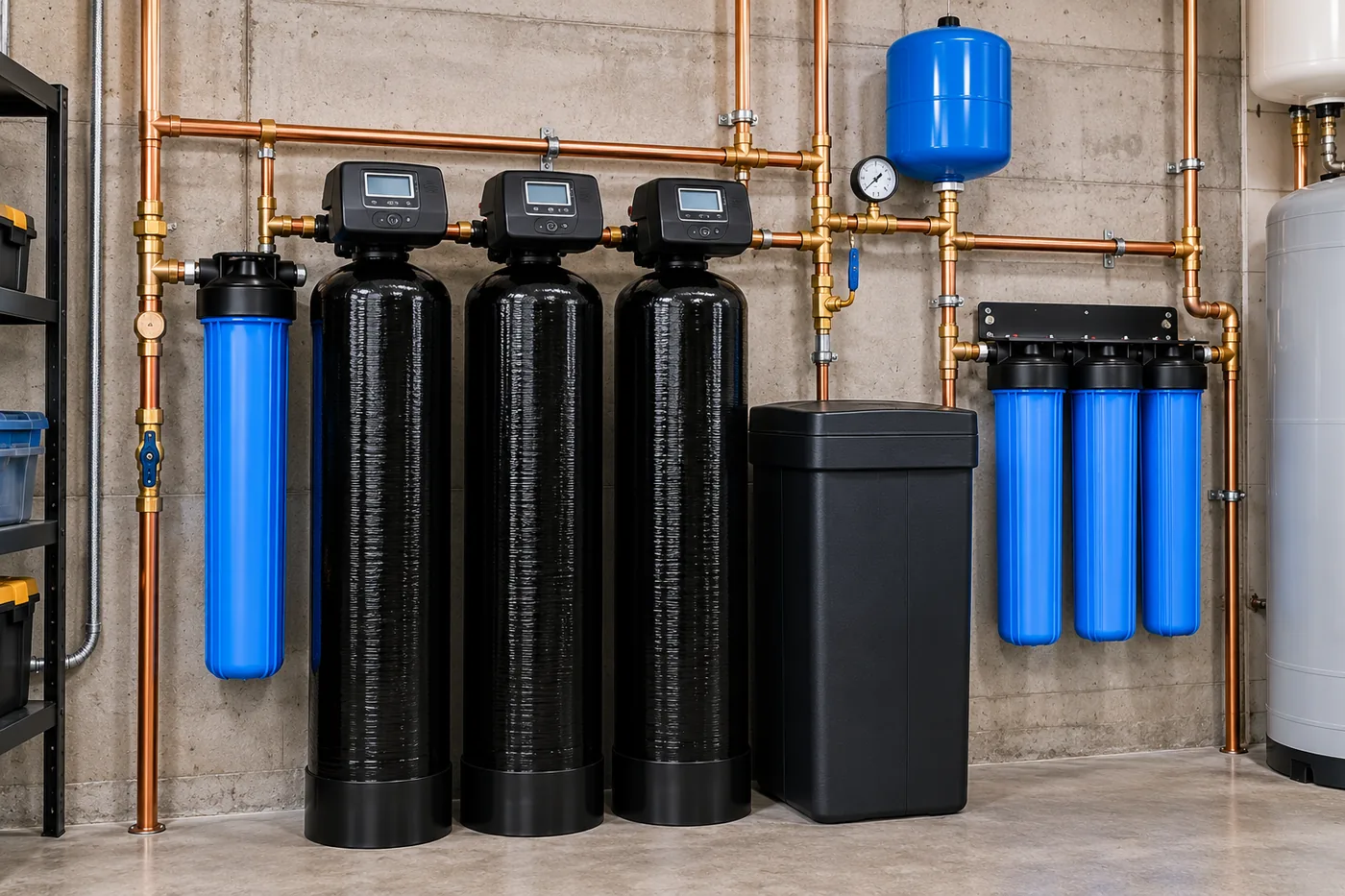
White crust on your faucets. Spots on glasses straight out of the dishwasher. Soap that will not lather and laundry that comes out stiff. A water heater that died years earlier than it should have. That is hardness, and a softener is the only thing that actually removes it.
Water softeners for Union, NJ and Union Township
A softener is the only thing that genuinely removes hardness, and hardness is what is behind the white crust on your fixtures, the spots on glassware, the stiff laundry and the water heater that died years early. On this page we cover the full range: ion-exchange softeners sized by grain capacity, twin-tank systems for households that cannot tolerate a regeneration gap, salt-free conditioners for people who want scale control without adding sodium, and the prefiltration that keeps resin beds from fouling. Sizing is not guesswork — it is your hardness in grains per gallon multiplied by household water use, which is why systems are sold in 32,000 and 48,000 grain capacities. Getting that number wrong means either constant regeneration or a system that never keeps up. We test first, we answer 24 hours a day, and the on-site test is free.
Specifically, we install and service metered ion-exchange softeners, twin-tank and single-tank systems, salt-free scale conditioners, brine tank and resin service, bypass valve work, control valve programming and sediment prefiltration ahead of the resin. We work in Union Township only. One honest boundary: a salt-free conditioner does not remove hardness. It reduces scale formation, which is genuinely useful, but your test numbers will not change and we will not pretend otherwise. Call (973) 380-3906.
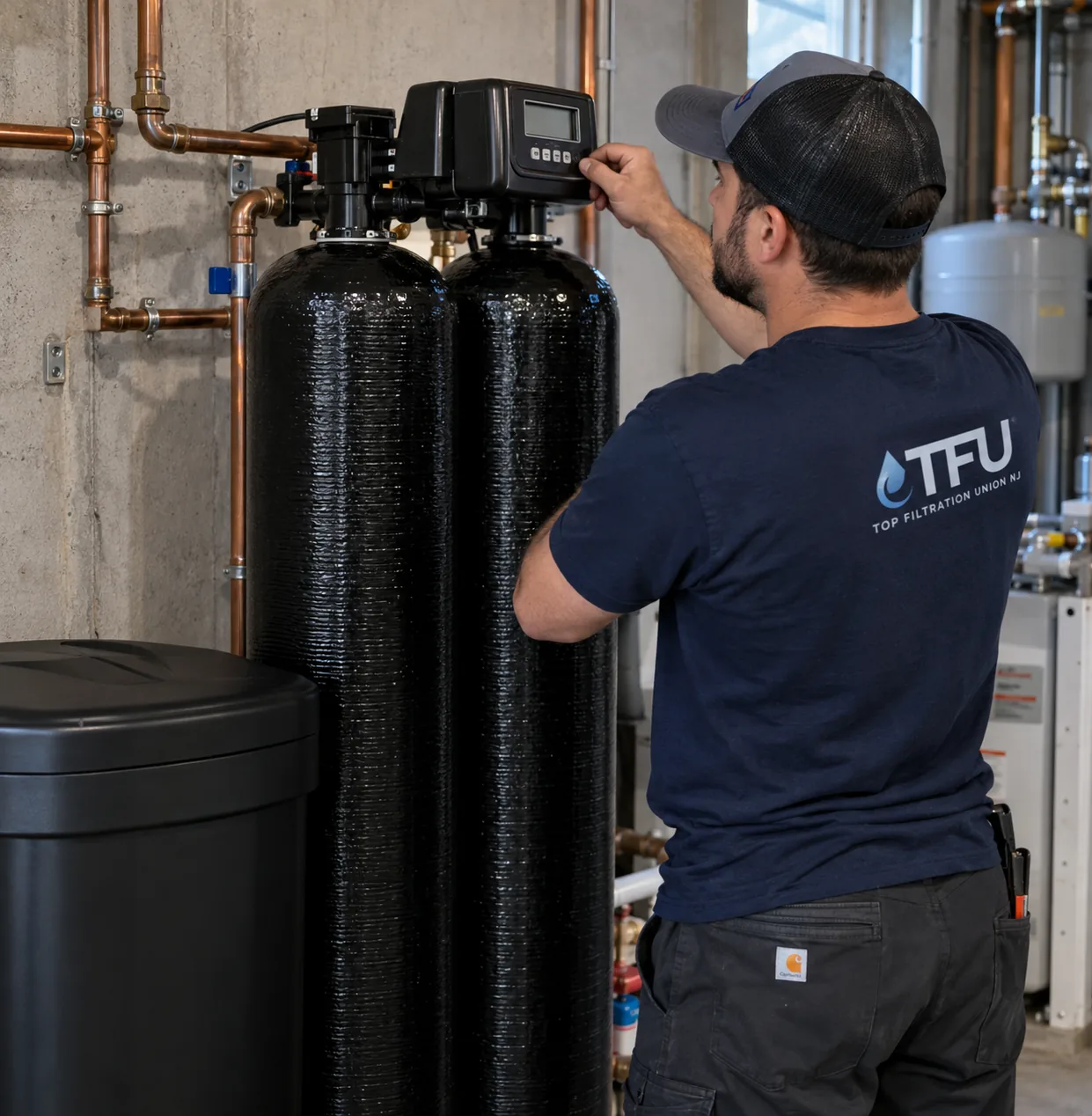
Every system below is sized from a measured hardness number and quoted in writing. Pick the closest match or call and describe what your water is doing.
Sized from your measured hardness and household use, not a rule of thumb. Installed with a bypass, quoted in writing.
See Softener Installation & SizingMetered regeneration set to your household so you are not wasting salt or water. Serviced throughout Union.
See Control Valve ProgrammingGrit destroys resin and control valves. We fit sediment prefiltration ahead of every softener we install.
See Prefiltration for SoftenersA working bypass means your house keeps running during maintenance. We fit and service them across Union.
See Bypass Valve ServiceScale control without adding sodium — useful, but it does not remove hardness, and we will say so.
See Salt-Free ConditionersStuck in regeneration, overflowing brine tank or salt-tasting water? We answer nights and weekends countywide.
See 24/7 Emergency Softener ServiceA softener stuck mid-regeneration will run water to drain continuously, and a failed float in the brine tank can flood a basement floor overnight — both worth calling about immediately rather than in the morning. We answer live 24 hours a day, 7 days a week, holidays included, and we can walk you through the bypass valve while we are en route. Salt that simply needs topping up, or a regeneration schedule you want adjusted, is a normal scheduled visit.
A softener sends your water through a tank of resin beads that hold sodium ions. As hard water passes through, the calcium and magnesium responsible for scale trade places with that sodium — they stay on the resin, and the water that leaves is soft. When the resin fills up, the system regenerates by flushing itself with brine drawn from a salt tank, and the cycle starts again.
Sizing is the part that gets done wrong. Capacity is your water hardness in grains per gallon multiplied by how much water your household actually uses, which is why softeners are sold in grain capacities like 32,000 and 48,000. An undersized unit regenerates constantly, burns through salt and wears out early. An oversized one sits with stale resin between regenerations. We size from your real hardness number and your real household, not a rule of thumb.
Being clear about the limits matters more than the marketing. Here is an honest split, so you know whether this is the system your house needs or whether you need something alongside it.
The most commonly recommended budget option in the industry, and for good reason. For a family of four, the 48,000-grain configuration is the frequent pick. The real argument for it is the valve: Fleck is the most widely serviced control valve there is, so parts and knowledgeable service will be available a decade from now.
Worth it if you want smarter regeneration and a stronger warranty. The SpringWell SS1 is praised for Bluetooth-controlled regeneration and a lifetime warranty. The SoftPro Elite is known specifically for using significantly less salt over its life, which adds up.
An honest caveat first: these do not soften water. They condition it so that scale is far less likely to form and stick, but the hardness minerals are still there. In exchange you add no sodium, use no salt and need no drain line.
A softener needs four things in one place: a spot on the main line, a nearby drain for regeneration water, an electrical outlet, and a bypass valve so the house can run while the unit is serviced. In newer homes there is sometimes a pre-plumbed “softener loop” waiting in the garage or basement. In the older Union housing stock, more often than not we are creating that space.
Most homeowners want one line left alone: we commonly leave the cold feed to the kitchen sink unsoftened, so your drinking and cooking water keeps its mineral content and adds no sodium. New Jersey code generally requires an air gap on the regeneration drain, and we install it that way.
Worth knowing before you buy
If you take one thing from this page: choose a system built on a Fleck or Clack control valve. Those two have by far the best long-term parts availability, which means that in eight years your softener is a repair, not a replacement. Proprietary valves from short-lived brands are how people end up buying the same system twice.
Every filtration system is a maintenance commitment, and the honest number matters more than the purchase price. Here is what this one asks of you. We track your intervals and remind you.
| Task | Interval |
|---|---|
| Add salt | Check monthly, refill every 1–2 months |
| Check for salt bridging | Every few months |
| Clean the brine tank | Annually |
| Resin bed replacement | Typically 10–15 years |
We would rather you verified this than took our word for it. None of these are ours, none of them sell equipment, and all of them are free to read before you spend anything.
Still working out which system you need? Start with our full list of water treatment services in Union, read how we test before we sell, or book a free on-site water test. Most Union homes need one or two of these systems — not all six.

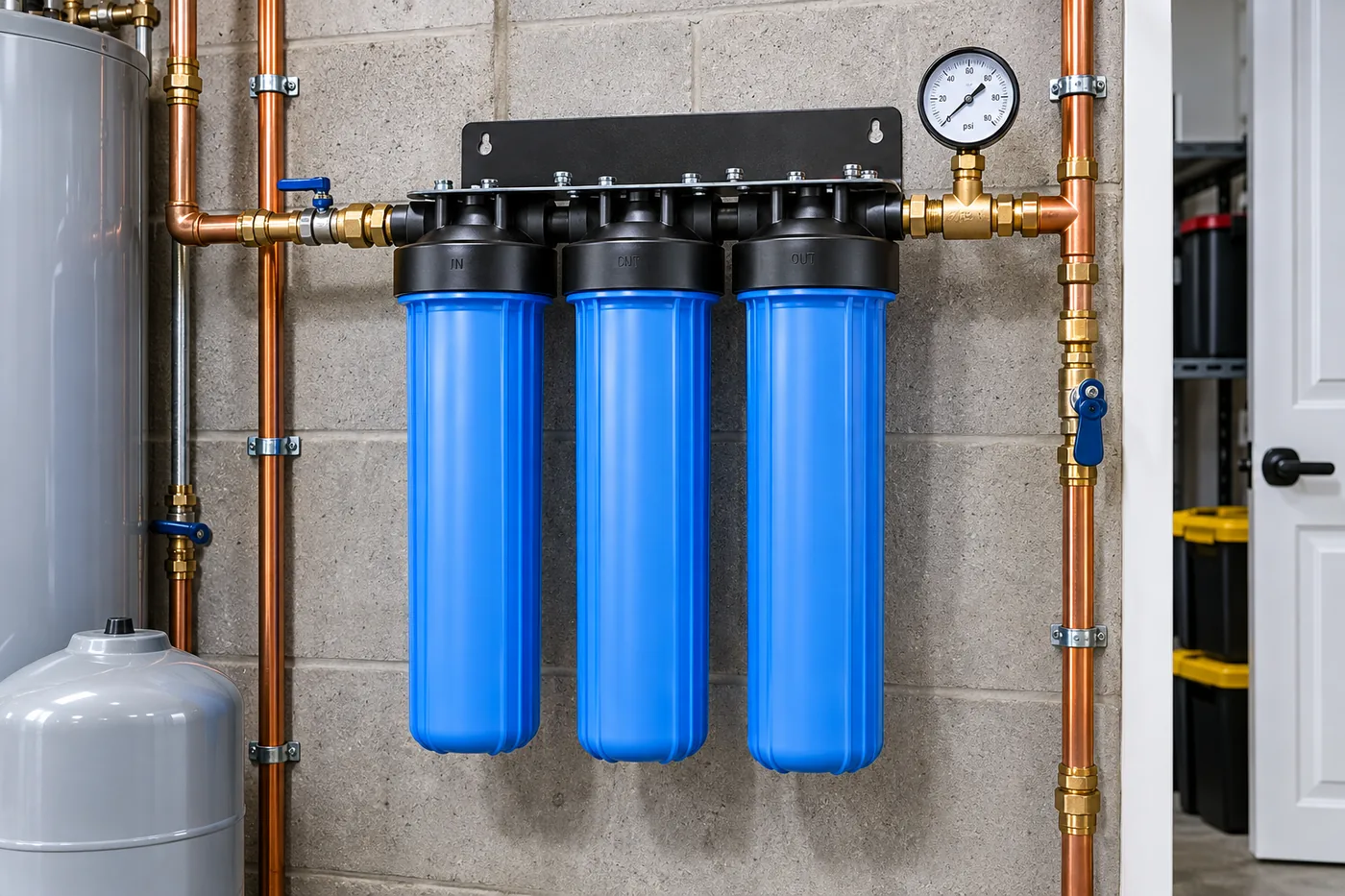
Hardness across Union sits high enough to cause real, visible scale in most homes we test, and the effect compounds in the township’s postwar housing stock where original water heaters and boilers have been quietly scaling for decades. Every millimetre of scale inside a heater costs efficiency, which is why hardness usually shows up on an energy bill long before anyone connects the two. The complication here is that older homes also shed rust from ageing supply lines, and grit will chew through a softener’s control valve and foul the resin bed if nothing is filtering ahead of it. We work in Union Township only and we never install a softener without sediment prefiltration in front of it.
Why Top Filtration
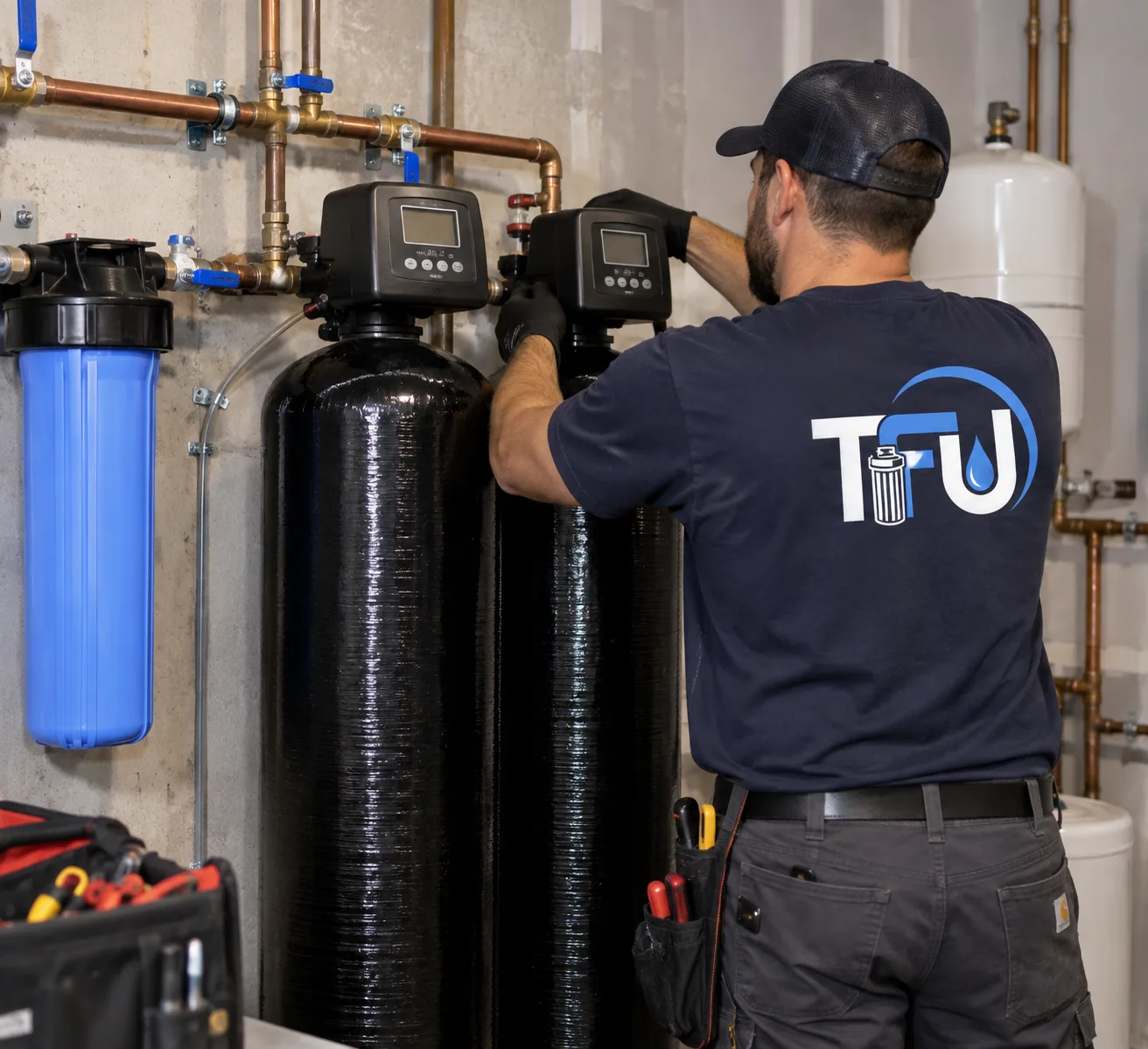
Grain capacity is arithmetic: hardness in grains per gallon times the water your household actually uses. Sell a 32,000-grain unit into a hard-water house of five and it regenerates constantly, burning salt and water and wearing out early. Sell one twice the size it needs and the resin sits idle between cycles. Big-box retailers sell by household size alone because they have no hardness number to work from, and that is the single most common reason we get called to replace a softener that is only a few years old. Softener installs tie into your main line and need a drain, which brings them under the New Jersey Uniform Construction Code (N.J.A.C. 5:23); Union Township requires a licensed plumber and a permit, and softener drains need a proper air gap. We bring a licensed plumber in for that work and handle the permit and inspection in Union Center, Townley, Larchmont and every other part of town.
Pricing, explained
Softener pricing moves on grain capacity, valve quality and install conditions. A single-tank metered softener on a straightforward basement line is the common case; twin-tank systems for households that cannot tolerate a regeneration gap cost more, and premium control valves cost more again but are far better supported for parts a decade out. The install side depends on whether you have a nearby drain, an outlet, and a pre-plumbed softener loop. We do not quote softeners blind over the phone — we measure hardness and look at the space. Call (973) 380-3906.
We answer 24 hours a day and can usually be out the same day across Union. If you would rather start with photos, send them and we will give you a range before we visit.
Call or Text (973) 380-3906Often Paired With
Water treatment works as a chain, and order matters. Here is what commonly sits alongside water softeners in a Union home.
Free Quote · Open 24/7
Free on-site quote, honest sizing and a written price before any work starts. We answer the phone 24 hours a day.